Branded Memories

25-Year Retrospective Edition Series
Launches August 1, 2026

Visual poetry
from an ordinary
America.

Twenty-five years of photographic collage. The first piece — El Camino — opens the edition series August 1, 2026. America’s 250th. Summer of muscle cars. Hand-numbered, limited to 36 per size.

First Edition · 25-Year Retrospective

El Camino

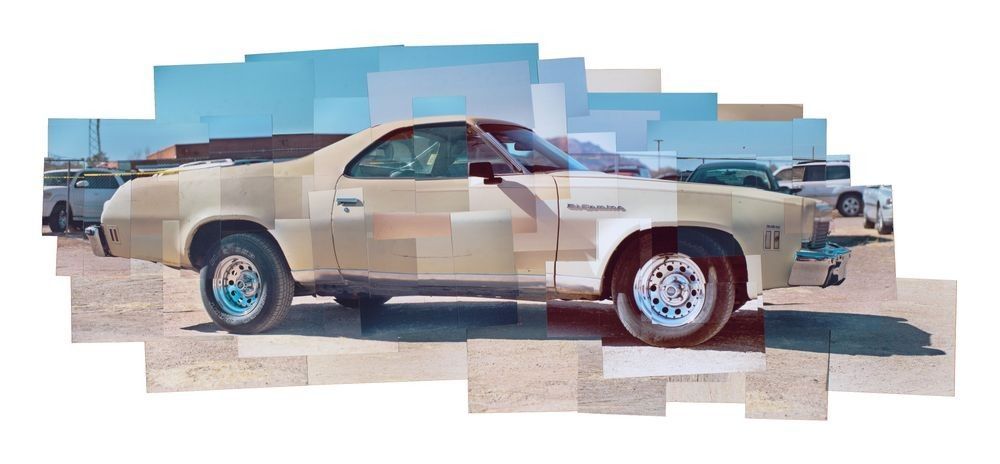
The first piece of Jason Harris’ 25-Year Retrospective Edition Series. Photographed in the Tucson desert on Kodak 35mm 200 ISO. Composed by hand from 85+ frames — no digital compositing. Limited, signed, numbered. 36 editions per size, edition-progression priced. Opens August 1, 2026 — America’s 250th, summer of muscle cars.

El Camino — photographic collage by Jason Bennett Harris, panoramic composite of a 1976 El Camino in the Tucson desert reconstructed from hundreds of fragments

The original El Camino is owned by Chicago art collector and car enthusiast Eliot Dam.

A case study on framing: El Camino →

Edition opens August 1, 2026 · 9:00 AM PT

--Days
--Hours
--Minutes

Edition-progression pricing. Each size steps up in price as its edition sells — the first 12 collectors secure the opening price, the next 12 pay Tier 2, and the final 12 pay Tier 3. Early conviction is rewarded; the price only rises from here.

Small

24″ × 11″

Tier 1 · Editions #1–12Opening Price$225
Tier 2 · Editions #13–24$275
Tier 3 · Editions #25–36$350

36 editions, each numbered. Smooth Fine Art Paper II — Hahnemühle Photo Rag. Certificate of authenticity.

The price steps up as each dozen sells — it will never be lower than today’s tier.

Medium

35″ × 16″

Tier 1 · Editions #1–12Opening Price$375
Tier 2 · Editions #13–24$475
Tier 3 · Editions #25–36$600

36 editions, each numbered. Smooth Fine Art Paper II — Hahnemühle Photo Rag. Certificate of authenticity.

The price steps up as each dozen sells — it will never be lower than today’s tier.

Large

48″ × 22″

Tier 1 · Editions #1–12Opening Price$525
Tier 2 · Editions #13–24$675
Tier 3 · Editions #25–36$850

36 editions, each numbered. Smooth Fine Art Paper II — Hahnemühle Photo Rag. Certificate of authenticity.

The price steps up as each dozen sells — it will never be lower than today’s tier.

Inner Circle · Edition Series Access

48-hour early access

Join the list for first access to the El Camino edition and future drops in the 25-Year Retrospective Series. Inner-circle subscribers receive 48-hour early access before public launch and an essay on the work shipped with every print.

No spam. Unsubscribe anytime. Used only for edition series announcements and inner-circle previews.

Portfolio

Artworks

Twenty-five years of hand created, individual photographic collage artworks. The Portfolio Retrospective — thirteen works spanning the practice.

Series 01

Portfolio Retrospective · 2006–2025 · Constructed photographic collage on 35mm film

El Camino

01

El Camino

Tucson, AZ · Kodak 35mm · 32” × 18”

Sold · Prints Available
Gas Boy

02

Gas Boy

Taylor Statten Camps, Algonquin Park, Ontario · 32” × 36”

Available
Habib Bros.

03

Habib Bros.

Habib Bros. Oil Co. · Walsenburg, CO · 34” × 22”

Available
Urinals

04

Urinals

The Standard Club, Chicago, IL · Kodak 35mm · 50” × 42”

Available
Swan Oyster Depot

05

Swan Oyster Depot

San Francisco, CA · Kodak 35mm · 24” × 18”

Available
Carnival Barkers

06

Carnival Barkers

Paris, France · Kodak 35mm · 24” × 20”

Available
The Old Showerhouse

07

The Old Showerhouse

Camp Ojibwa · Eagle River, WI · Kodak 35mm · 32” × 20”

Available
Branded Memories

08

Branded Memories

Blockbuster Video · Winnetka, IL · Kodak 35mm · 42” × 26”

Available
Bryce Canyon

09

Bryce Canyon

Bryce Canyon, UT · Kodak + CineStill 800T · 42” × 30”

Available
99¢ Store

10

99¢ Store

Wilshire Blvd near LACMA · Los Angeles, CA · Kodak 35mm · 24” × 14”

Available
Fenway Park

11

Fenway Park

Fenway Park, Boston, MA · Kodak 400 · 36” × 32”

Available
New Bev

12

New Bev

New Beverly Cinema, Los Angeles, CA · CineStill 800 · 50” × 28”

Available
Flamingo

13

Flamingo

Las Vegas, NV · CineStill 800 · 54” × 24”

Available

The Artist

Jason Bennett Harris

Portrait of Jason Bennett Harris

For over twenty-five years, I have been photographing the places that hold America together — the gas pump, the motel sign, the video store, the dollar store, the oyster counter, the camp bathroom sink basin.

I use film because film remembers differently than digital. I use collage because a single photograph can only tell you what something looked like. Multiple photographs, assembled by hand in multiple passes, can tell you what something felt like — and what it will feel like to have lost it.

My process begins with a frame. I shoot on 35mm film with my trusty Nikon 50 — Kodak 100 through 400 ISO for daylight; CineStill 800T for the night work — developing prints that I layer and assemble by hand. No digital compositing. Each pass through the collage artwork adds another element, another angle, another moment. The subject accumulates. The subject teases. The subject repeats. What remains is the feeling of having truly looked.

I see the world in a connected manner. The El Camino, the shuttered Blockbuster, and the 99¢ store are not separate subjects. They are the same subject: the American institution that made a promise to everyone and then quietly stopped keeping it. I am part cultural documentarian, part portraitist. And these are my subjects.

A new body of work — Japanese Tapestries — marks a new chapter: bright neon shot at night on CineStill 800T film in Tokyo and Kyoto/Osaka in March 2026, informed by studio visits with leading art curators Alex Skull, Shirley Morales, and others who have pushed my practice into new territory. Targeted for a Fall/Winter 2026–2027 Los Angeles exhibition.

Forthcoming

New Series · 2026–2027

Japanese Tapestries — neon photographic collage by Jason Bennett Harris

Next · Fall / Winter 2026 · Los Angeles

Japanese Tapestries

Shot at night on CineStill 800T across Tokyo and Kyoto in March 2026, Japanese Tapestries turns the electric language of Japanese street neon into hand-assembled photographic collage. The film’s tungsten base renders the neon with an ethereal glow, yielding original tapestries of vivid, woven color. Less document than cloth of light, the work is built to travel: I see each “tapestry” extending into collaborations with brands and creators — denim, tees, umbrellas, paper folios. Premiering Fall/Winter 2026 in Los Angeles, with commercialization in Tokyo and Kyoto.

Phases of the Moon — photographic collage by Jason Bennett Harris

Following · Spring / Summer 2027 · Los Angeles

Phases of the Moon

Shot at the Union 76 station on PCH — by day on Kodak 400 and by night on CineStill 800T — Phases of the Moon distills the lunar month into eight images. By interleaving daylight and tungsten film, each panel traces the cycle from new to waxing to full to waning, the same roadside icon transformed by the changing light. Built from hundreds of frames, the series pushes my collage practice further toward abstraction. Following Japanese Tapestries, it arrives Spring/Summer 2027 in Los Angeles.

Open to Partnership

Collaboration

Three areas where the twenty-five-year archive is ready to travel — and where I’d like to work with one or two thoughtful partners over the next twenty months. Relationship-led, archive-anchored, structured as licensing or a co-produced limited drop. Reach out if any of this maps to what you’re building.

I

Auto / Americana

The retrospective is full of American iconography — El Camino, Gas Boy, Habib Bros. If you’re building a brand, an exhibition, or an editorial moment around the American road, I’d like to talk.

II

Apparel & Design

Joiner-style imagery translates onto fabric, packaging, and printed objects. Looking for one apparel or design partner whose audience already speaks the visual language of the archive.

III

Licensing

One licensing deal across the next twenty months — agency, brand, label, editorial, or cultural institution. A single work or series, clear terms, placed in front of a new audience without diluting the practice.

Conversations begin with the archive — show me what you see.

jasonbennettharris@gmail.com →

Collector Story · First Edition

The Framing of El Camino

How collector Eliot Dam gave the first work in the retrospective its permanent home

By Jason Bennett Harris

When a one-of-a-kind artwork leaves the studio, the artist’s work is finished — but the collector’s has just begun. El Camino, the first piece in the 25-Year Retrospective and the first to enter a private collection, is built from more than eighty-five hand-cut photographic prints, layered and assembled without a single digital intervention. It is, by its nature, a fragile object: paper, emulsion, adhesive, and air. How it would be protected — and presented — mattered enormously.

Chicago art collector and car enthusiast Eliot Dam understood that from the start.

The artist and collector Eliot Dam at the framer’s workbench with the unframed El Camino.

Rather than flattening the collage behind standard glazing, Eliot chose an elegant custom picture box — a deep, 3” inch wood shadow box finished in clean gallery white, fitted with museum-quality anti-reflective glass. It was the right decision on every count. The specialized glazing filters the UV light that fades photographic prints over decades, while its anti-reflective coating makes the glass all but disappear. Stand in front of the work and there is no glare to fight, no window between you and the piece — just the artwork itself, as present as it was on the studio table.

But the quiet brilliance of Eliot’s framing choice is in the depth — and the distance.

Eliot Dam weighing the framing decision — moulding samples and mat corners against the prints.

A photographic collage is not a photograph. It has topography — dozens of overlapping prints, each casting its own hairline shadow, each sitting a paper’s thickness above or below its neighbor. Press it flat behind glass, and that dimension dies. Eliot’s shadow box does the opposite. The artwork was mounted on a quarter-inch foam core backing and set against an eggshell mat that provides a full three to four inches of open space between the edge of the collage and the white wood frame.

That generous border is not empty — it is working. The distance gives the artwork room to command its own field, accentuating every irregular edge of the composition, while the raised mounting lifts the collage off the back of the frame and holds the glass well away from its surface. The result is that El Camino appears to float inside the box — suspended, weightless, with room to breathe.

The eggshell mat and white wood shadow box against the hand-cut prints — the space that lets the work float.

The effect on the viewer is exactly what this work was made for. From across the room, your eye goes directly to the whole image: the sun-bleached Chevrolet at rest in the Tucson desert, the sky breaking into blue-grey panels above it. Then the floating depth pulls you closer. You begin to see the individual parts — the single frame that holds a chrome bumper, the seam where two skies meet, the shadow assembled from three different prints. The dimensionality that was built into the work by hand, print by print, is preserved and amplified. The frame doesn’t just protect the collage; it completes the experience of reading it.

There’s a nice symmetry in who made this choice. Eliot is a collector of art and a lover of automobiles — and El Camino is precisely where those two passions meet. He didn’t simply acquire the piece; he considered it, the way a car enthusiast considers what a great machine deserves. The framing session — moulding samples on the workbench, mat corners tested against the prints — was its own kind of collaboration.

El Camino framed and wrapped, ready for the journey to the collector’s home in Chicago.

A note on the practice: framing is always in addition to the purchase of the artwork, and it is anything but an afterthought. It exists to accentuate the work and complete it — a holistic presentation in which the piece and its habitat speak the same language. As an artist and a designer, I consider this alignment critical: the collage and the frame that houses it should feel inevitable together, each made better by the other. Eliot’s choices are a model of what that looks like.

The original El Camino now hangs in Eliot’s home in Chicago, floating in its white box, built to be looked at for a lifetime. Limited edition prints, in three sizes and affordable early collector pricing, opens August 1, 2026.